Wayside exhibits · Katy Trail State Park
Thirty‑five years of the Katy, 1990–2025.
From the last MKT train to the national Rail‑Trail Hall of Fame. This is the anniversary panel riders find at the Rocheport and North Jefferson trailheads, transcribed in full.
An interpretive panel of Missouri State Parks, a division of the Missouri Department of Natural Resources · Funding provided by Edward Jones · Standing at 2 trailheads on this section
 ⤢ Zoom the original
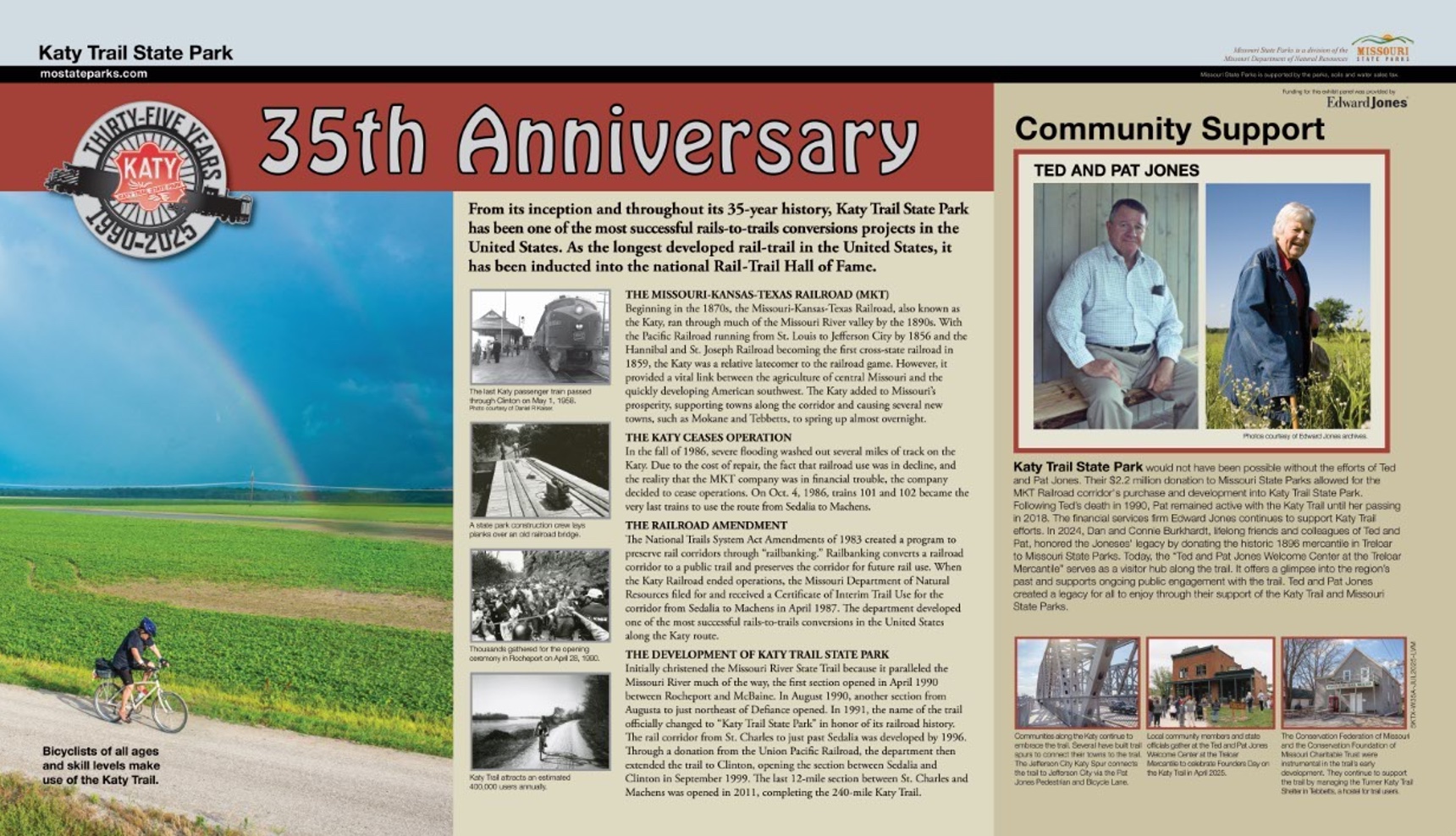
From its inception and throughout its 35-year history, Katy Trail State Park has been one of the most successful rails-to-trails conversions projects in the United States. As the longest developed rail-trail in the United States, it has been inducted into the national Rail‑Trail Hall of Fame.
The Missouri‑Kansas‑Texas Railroad (MKT)
Beginning in the 1870s, the Missouri‑Kansas‑Texas Railroad, also known as the Katy, ran through much of the Missouri River valley by the 1890s. With the Pacific Railroad running from St. Louis to Jefferson City by 1856 and the Hannibal and St. Joseph Railroad becoming the first cross-state railroad in 1859, the Katy was a relative latecomer to the railroad game. However, it provided a vital link between the agriculture of central Missouri and the quickly developing American southwest. The Katy added to Missouri’s prosperity, supporting towns along the corridor and causing several new towns, such as Mokane and Tebbetts, to spring up almost overnight.
The Katy ceases operation
In the fall of 1986, severe flooding washed out several miles of track on the Katy. Due to the cost of repair, the fact that railroad use was in decline, and the reality that the MKT company was in financial trouble, the company decided to cease operations. On Oct. 4, 1986, trains 101 and 102 became the very last trains to use the route from Sedalia to Machens.
The railroad amendment
The National Trails System Act Amendments of 1983 created a program to preserve rail corridors through “railbanking.” Railbanking converts a railroad corridor to a public trail and preserves the corridor for future rail use. When the Katy Railroad ended operations, the Missouri Department of Natural Resources filed for and received a Certificate of Interim Trail Use for the corridor from Sedalia to Machens in April 1987. The department developed one of the most successful rails-to-trails conversions in the United States along the Katy route.
The development of Katy Trail State Park
Initially christened the Missouri River State Trail because it paralleled the Missouri River much of the way, the first section opened in April 1990 between Rocheport and McBaine. In August 1990, another section from Augusta to just northeast of Defiance opened. In 1991, the name of the trail officially changed to “Katy Trail State Park” in honor of its railroad history. The rail corridor from St. Charles to just past Sedalia was developed by 1996. Through a donation from the Union Pacific Railroad, the department then extended the trail to Clinton, opening the section between Sedalia and Clinton in September 1999. The last 12-mile section between St. Charles and Machens was opened in 2011, completing the 240-mile Katy Trail.
From interpretive panel W035, “35th Anniversary” · © Missouri State Parks, a division of the Missouri Department of Natural Resources · Funding for the exhibit panel provided by Edward Jones · Jones photographs courtesy of the Edward Jones archives · Presented here with permission, as part of the Katy Trail 360 demonstration.
Stand where it stands
This panel is at both ends of the captured section.
Each link drops into the 360 at the trailhead, with the panel marker in view.